What Is Network Security? Types, Basics & Why You Need It
DDoS downtime costs $218,000 per hour, and 61% of firms now run zero trust. Network security explained — the 4 types, how it works, and where to start.
By Arica Tech Security Team
Every device you own is having conversations you never see. Your laptop talks to dozens of servers before you finish your coffee; your phone chats with networks in three countries by lunch. Network security is the discipline that decides which of those conversations to allow — and it's become expensive to get wrong. A single hour of DDoS-driven downtime costs enterprises around $218,000, per NordLayer's 2025 cybersecurity statistics.
Whether you landed here as a student working through networking basics, an IT person leveling up, or a business owner wondering what your provider keeps billing you for — this guide covers what network security actually is, the four core types, how cryptography holds it together, and the zero-trust shift rewriting the rules.
Key Takeaways
- Network security protects data as it moves between devices — controlling who connects, what they can reach, and whether traffic can be read or tampered with.
- The four core types: firewalls, intrusion detection/prevention, VPNs and encryption, and access control (NAC).
- The perimeter model is dying: 61% of organizations now run zero-trust initiatives, up from 24% in 2021 (Expert Insights, 2025).
Related: what is cybersecurity
What Is Network Security?
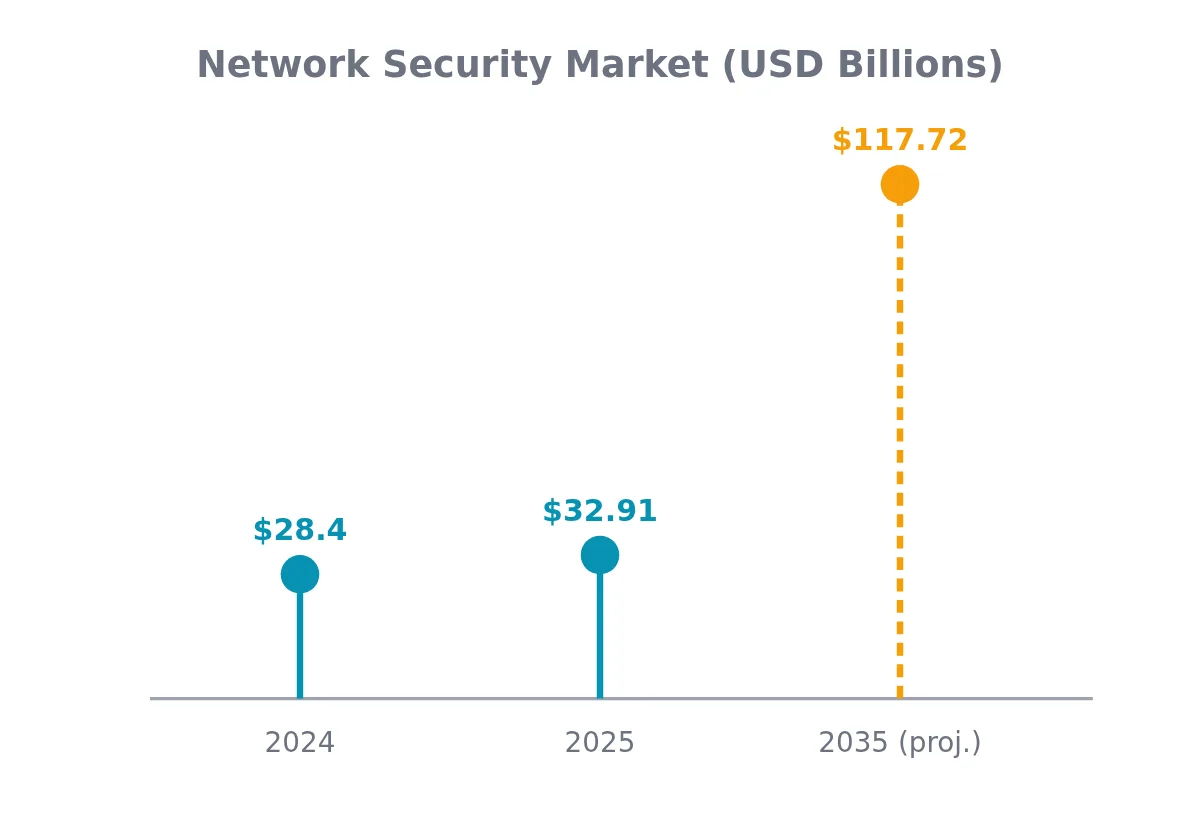
Network security is the set of technologies, policies, and practices that protect a computer network — and the data traveling across it — from unauthorized access, misuse, and attack. It's a big enough job that the global network security market reached $32.91 billion in 2025, projected to hit $117.72 billion by 2035, per Roots Analysis' network security market report.
If cybersecurity is the whole defensive discipline, network security is its transport layer: it guards data in motion. Files sitting on your laptop are endpoint security's problem. The moment they travel — to a server, a colleague, the cloud — network security takes over.
Its three jobs mirror the classic CIA triad:
- Keep outsiders out — only authorized users and devices connect (confidentiality)
- Keep traffic honest — nobody intercepts or alters data mid-journey (integrity)
- Keep the network up — services stay reachable despite attacks like DDoS (availability)
Wondering how this relates to "cybersecurity exactly"? Network security is one of the six domains of cybersecurity — the one focused on the roads rather than the buildings.
Why Do We Need Network Security?
Because the network is where attackers travel, even when it's not where they break in. In 2025, stolen credentials were the initial access vector in 22% of breaches per Verizon's Data Breach Investigations Report — and once inside, attackers move through the network to find what's worth stealing. Network security decides how far they get.
The case in three numbers:
- 8 million — DDoS attacks recorded in just the first half of 2024, up 13% year-over-year, per ASEE's cybersecurity statistics compilation. Availability is under constant, automated assault.
- $4.44 million — the global average cost of a data breach in 2025, per IBM's Cost of a Data Breach Report. Network segmentation is often the difference between a contained incident and a company-wide one.
- $218,000 — enterprise cost per hour of DDoS downtime (NordLayer, 2025). For e-commerce, the meter runs faster.
Here's the mental model that makes it click: a breach is rarely one event. It's a chain — get in, look around, move sideways, take data out. Endpoint security fights the first link. Network security fights every link after it. That's why flat networks (where every device can reach every other device) turn small compromises into disasters, and segmented networks turn would-be disasters into Tuesday incidents.
Related: what is antivirus software
What Are the 4 Types of Network Security?
Four categories form the core, and most other tools are elaborations of them. Together they're why firewalls alone — a market worth $8.55 billion in 2025 per Expert Market Research — no longer count as a complete strategy.

| Type | What it does | Everyday analogy |
|---|---|---|
| 1. Firewalls | Filter traffic entering and leaving the network based on rules | The security guard checking IDs at the door |
| 2. Intrusion Detection & Prevention (IDS/IPS) | Spot and block attack patterns inside traffic | CCTV that calls the police itself |
| 3. VPNs & Encryption | Scramble data in transit so intercepted traffic is unreadable | Sealed envelopes instead of postcards |
| 4. Access Control (NAC) | Verify who and what may join the network, and what each can reach | The keycard system deciding which floors you can visit |
The extended family, briefly: network segmentation (internal walls limiting sideways movement), email and web filtering (blocking malicious links before users click), DDoS protection (absorbing flood attacks), and wireless security (WPA3 for Wi-Fi). Each maps back to one of the four cores — walls, watchers, envelopes, or keycards.
The honest note for exam-takers: different textbooks slice "the types" differently — some count segmentation separately, some fold VPNs into encryption. Learn the four functions above and you can answer any version of the question.
How Does Cryptography Fit Into Network Security?
Cryptography is the reason network security works at all on public infrastructure. Every packet crossing the internet passes through hardware you don't control — coffee shop routers, ISP switches, undersea cables. Encryption makes that acceptable: intercepted traffic becomes gibberish without the keys.
Where you meet it daily, whether you notice or not:
- TLS/HTTPS — the padlock in your browser. Encrypts web traffic between you and the site. The reason typing a password on public Wi-Fi isn't instant suicide.
- VPNs — an encrypted tunnel wrapping all your traffic, hiding it from local snoops and linking remote workers to office networks safely.
- WPA3 — encryption between your device and the Wi-Fi router, keeping neighbors out of your traffic.
- End-to-end encryption — messaging apps where even the provider can't read the content.
The under-taught insight: cryptography in networks solves two problems, and encryption is only one. The other is authentication — proving the server you reached is actually your bank and not a lookalike. That's what certificates do, and it's why "just look for the padlock" is incomplete advice: the padlock proves the connection is private, not that the site is honest. Phishing sites get padlocks too.
What Is Zero Trust, and Why Is Everyone Moving to It?
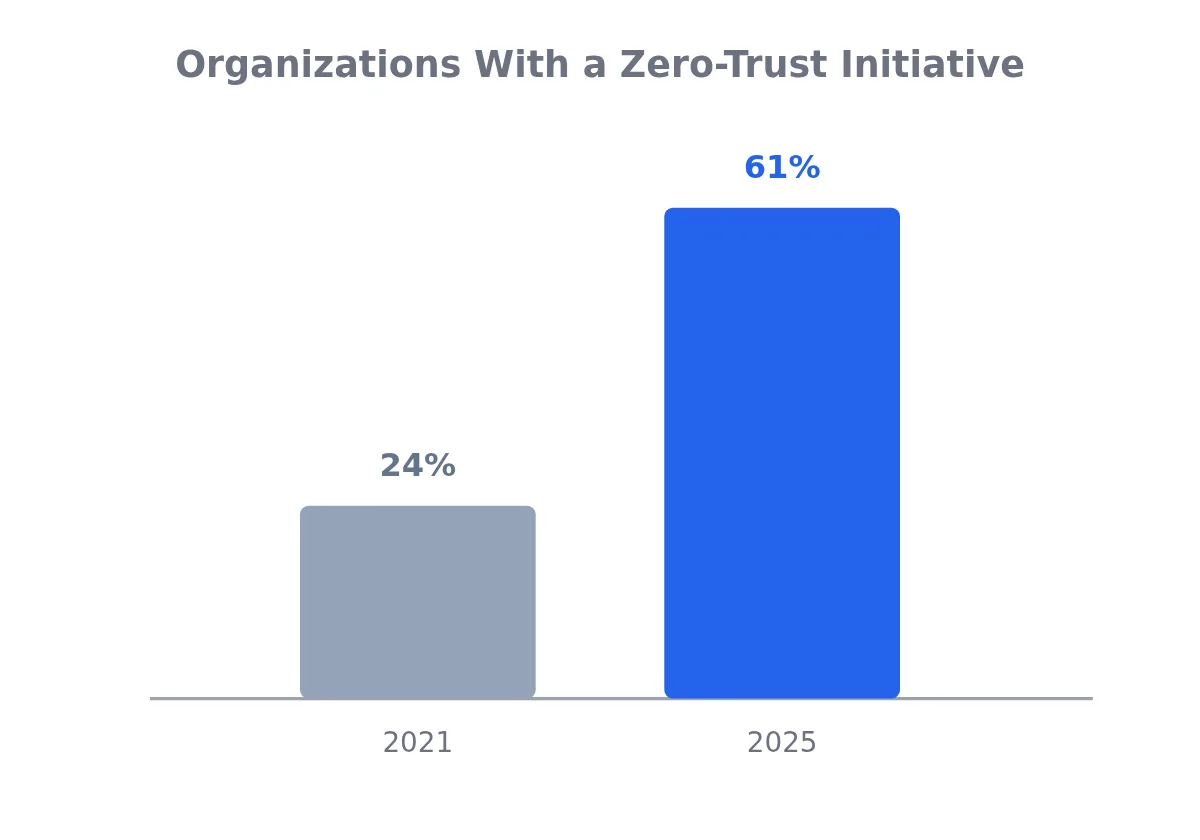
Zero trust is the model replacing the castle: instead of trusting everything inside the network perimeter, it trusts nothing and verifies everything, every time. Adoption tells the story — 61% of organizations had launched a zero-trust initiative by 2025, up from 24% in 2021, per Expert Insights' zero trust adoption research.
Why did the castle model die? Three reasons, all familiar:
- The perimeter dissolved. Remote work, cloud apps, and phones mean "inside the office network" describes almost nobody's workday anymore.
- Attackers log in, they don't break in. With stolen credentials driving 22% of breaches (Verizon, 2025), the "trusted insider" is often an attacker wearing a stolen badge.
- Flat networks amplify mistakes. One phished laptop in a trust-everything network reaches everything. In a zero-trust network, it reaches almost nothing.
In practice, zero trust means: every access request is authenticated and authorized individually, least-privilege is default, and the network assumes breach at all times. It's less a product than a redesign — which is why it's a multi-year initiative at most companies, not a purchase order.
Network Security Basics: Where Should You Actually Start?
Match the effort to the network. A home office and a 50-person company need different depths of the same fundamentals:
For home and home office:
- Change the router's admin password — the factory default is in public manuals attackers read too.
- Use WPA3 (or WPA2 minimum) with a strong Wi-Fi passphrase — the passphrase method applies here.
- Keep router firmware updated; enable auto-update if offered.
- Put smart-home gadgets on the guest network — your cheap IoT plug shouldn't share a room with your banking laptop.
- Turn off remote management features you don't use.
For small businesses, add:
- A business-grade firewall with IPS enabled — not the ISP's default box.
- Network segmentation: separate guest Wi-Fi, staff devices, servers, and payment systems.
- VPN (or zero-trust access) for anyone connecting remotely — never raw exposed remote desktop.
- MFA on every network entry point: VPN, email, admin panels.
- Log monitoring — an unwatched alert is a breach report you'll read later.
Want to know what your network looks like to an attacker? Arica Tech runs network security assessments — external scan, internal segmentation review, and a prioritised fix list. Book yours →
Frequently Asked Questions
What is network security in simple words?
Network security is protecting a computer network and the data moving through it from unauthorized access and attacks. It combines hardware and software — firewalls, encryption, intrusion detection, access controls — to control who connects and what they can do. The market hit $32.91 billion in 2025, per Roots Analysis.
What are the 4 types of network security?
The four core types are firewalls (filtering traffic), intrusion detection and prevention systems (spotting attacks in progress), VPNs with encryption (protecting data in transit), and network access control (verifying who joins). Segmentation, email filtering, and DDoS protection extend these four foundations.
What is the difference between network security and cybersecurity?
Cybersecurity is the umbrella covering all digital defense; network security is the subdomain protecting data in motion between devices. Endpoint security guards the devices, application security guards the software, and network security guards the connections — one of six domains under the cybersecurity umbrella.
What are the disadvantages of network security?
Cost, complexity, and friction. Tools and skilled staff are expensive — and misconfigured tools give false confidence. Strict controls can slow legitimate work, tempting users into workarounds. That's why modern practice (and NIST guidance) favors usable controls like SSO with MFA over piling on restrictions that users route around.
How do I learn network security?
Start with networking fundamentals — TCP/IP, DNS, routing — because you can't secure what you can't trace. Then layer security: CompTIA Network+ then Security+ is the classic certification path, and free labs like TryHackMe teach hands-on defense. With 61% of firms mid-zero-trust-rollout (Expert Insights, 2025), practical skills find work fast.
The Bottom Line
Network security is the discipline of controlling conversations: which devices may talk, what they may say, and who can listen. The fundamentals fit in a sentence each:
- Firewalls filter, IDS watches, encryption seals, access control verifies — the four types cover most exam questions and real deployments alike.
- The perimeter is gone; zero trust (61% adoption and climbing) is what replaced it.
- Cryptography does double duty: privacy and proof of identity. The padlock alone doesn't mean "safe."
- Flat networks are the silent killer. Segment before you need to have segmented.
Start where you are: home users, spend ten minutes on your router tonight. Businesses, ask one question — "if this laptop is phished tomorrow, what can it reach?" If the answer is "everything," you know your next project.
Related: credit card security guide
Sources
- Roots Analysis, Network Security Market Size, Share, Growth & Forecast, 2035, retrieved 2026-08-21, https://www.rootsanalysis.com/network-security-market
- Expert Insights, Zero Trust Adoption Statistics and Trends in 2025, retrieved 2026-08-21, https://expertinsights.com/network-security/zero-trust-adoption-statistics-and-trends
- NordLayer, Cybersecurity statistics 2025: trends, costs & insights, retrieved 2026-08-21, https://nordlayer.com/blog/cybersecurity-statistics-of-2025/
- ASEE, Cybersecurity statistics: 100+ stats to know in 2025, retrieved 2026-08-21, https://cybersecurity.asee.io/blog/cybersecurity-statistics/
- Expert Market Research, Network Security Firewall Market Size & Share, Growth 2035, retrieved 2026-08-21, https://www.expertmarketresearch.com/reports/network-security-firewall-market
- IBM, Cost of a Data Breach Report 2025, retrieved 2026-08-21, https://www.ibm.com/reports/data-breach
- Verizon, 2025 Data Breach Investigations Report, retrieved 2026-08-21, https://www.verizon.com/business/resources/reports/dbir/
Need this in your own environment?
Arica Tech Security runs VAPT, ISO 27001 readiness support, and digital forensics engagements for teams in India and beyond.