Credit Card Security: How to Protect Your Card in 2026
Card fraud hit $33.4 billion in 2024 and 73% of it happens online. Here's how credit card security actually works — and 10 ways to protect your card.
By Prathamesh Dabir
Your credit card number is probably worth less than your morning coffee. On dark web marketplaces in 2025, stolen card details sold for as little as $5, according to Panda Security's dark web statistics report. That's the uncomfortable math behind card fraud: your data is cheap, the tools to steal it are cheaper, and the losses add up to tens of billions every year.
The good news? Most card fraud is preventable, and the habits that stop it take minutes to set up. This guide covers what credit card security means in practice, how criminals actually get your card data, and the exact steps — ranked by impact — that keep your money where it belongs.
Key Takeaways
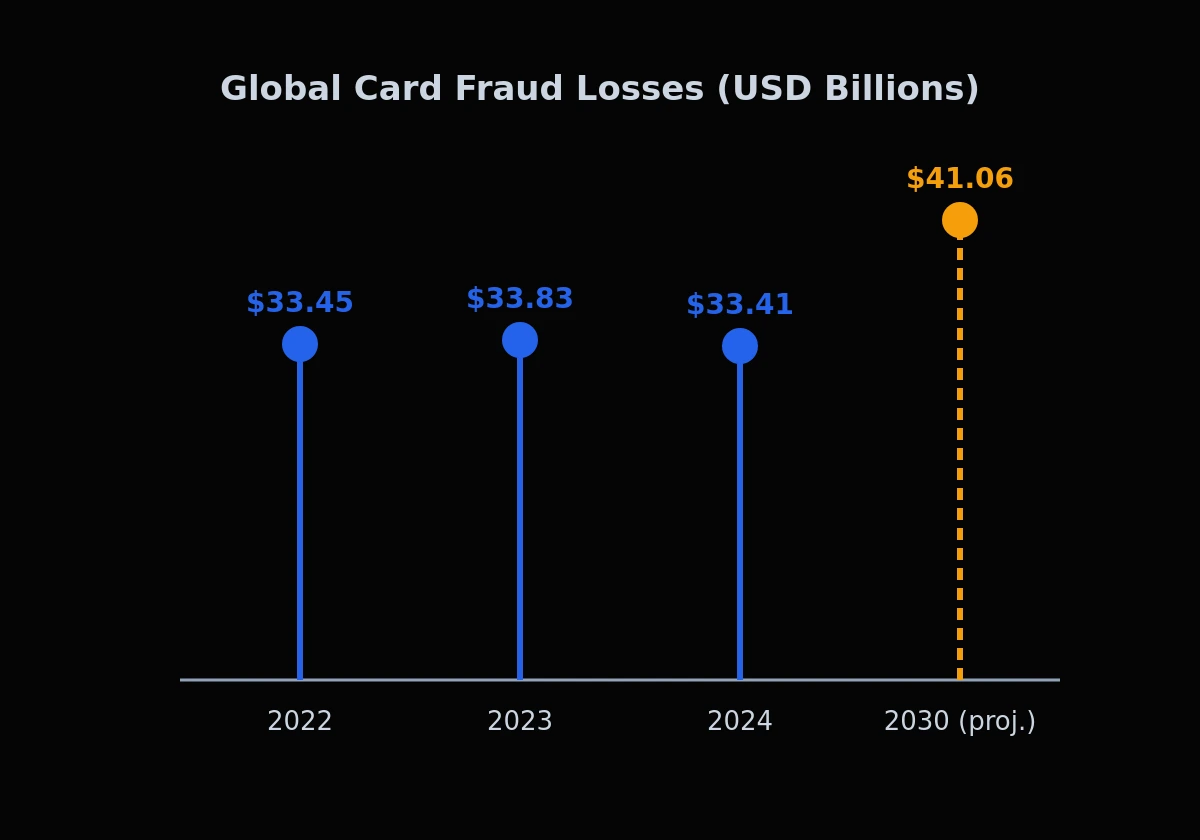
- Global card fraud losses reached $33.41 billion in 2024, and the Nilson Report projects they'll climb to $41 billion by 2030.
- 73% of US card fraud now happens online, where the physical chip in your card can't help you.
- Virtual card numbers, transaction alerts, and two-factor authentication stop the most common attacks — and all three are free.
Related: our cybersecurity consulting services
What Is Credit Card Security?
Credit card security is the set of technologies, regulations, and personal habits that protect card data from theft and misuse. It spans everything from the EMV chip in your wallet to the PCI DSS rules merchants must follow — and in 2024 it was tested by $33.41 billion in global fraud losses, per the Nilson Report's Card Fraud Losses Worldwide study.
Think of it as three layers working together:
- Network and issuer protections. Encryption, tokenization, real-time fraud scoring, and zero-liability policies from Visa, Mastercard, and your bank.
- Merchant obligations. The PCI DSS (Payment Card Industry Data Security Standard) dictates how any business that touches card data must store, transmit, and process it.
- Your habits. Alerts, strong passwords, virtual cards, and a healthy suspicion of "urgent" texts from your "bank."
The first two layers are largely out of your hands. This article focuses on the third — because that's where most successful attacks actually land.
How Big Is the Credit Card Fraud Problem in 2026?
In 2024, payment card fraud losses worldwide hit $33.41 billion, according to the Nilson Report's Card Fraud Losses Worldwide — 2024 analysis — and US cards alone were tied to 41.87% of that total. Looking forward, the same report projects losses of $41.06 billion by 2030 and a cumulative $407.6 billion over the next decade.
And the reports keep piling up. In the first three quarters of 2025, US consumers filed 503,450 credit card fraud reports with the FTC — nearly 180,000 more than the same period in 2024, according to FTC Consumer Sentinel data cited by The Motley Fool. One detail worth sitting with: 91% of those credit card identity theft reports involved new accounts opened in the victim's name, not stolen physical cards.
Why do the numbers keep growing even as security tech improves? Because the attack surface keeps growing faster. Every new checkout page, subscription service, and stored card is one more place your data can leak.
Related: incident response and forensics support
How Do Criminals Actually Steal Card Data?
Skimming, phishing, and data breaches remain the big three. In 2025, FICO's Card Alert Service identified more than 243,000 compromised debit cards from skimming — a 5% increase over 2024 — across more than 3,500 US financial institutions, per FICO's State of Card Skimming in the US: 2025 Year in Review. And that's just the physical side of the problem.
Here's the modern fraud toolkit, briefly:
- Skimmers and shimmers. Devices hidden inside ATMs, gas pumps, and point-of-sale terminals that copy card data. The US Secret Service prevented over $400 million in skimming-related losses in 2025 alone, per FICO.
- Phishing and smishing. Fake bank texts and emails. In 2025, text messages were the most-reported first contact method for fraud, tied to median losses of $1,000 per victim, per FTC Consumer Sentinel data cited by Experian.
- Data breaches. Your card leaks from a merchant's database, not your wallet. You did nothing wrong; you're compromised anyway.
- Dark web resale. Stolen data gets packaged and sold. In 2025, dark web listings featured more than 140 million stolen card records, according to Panda Security — and one marketplace alone advertised over 15 million cards.
The part most articles miss: fraud is now a subscription business. Stealer malware rents for $15 a month, and phishing kits that defeat two-factor authentication — like Tycoon 2FA — start at $120, per StingRai's 2026 dark web pricing research. A criminal doesn't need skills anymore. They need a login.
That's the real reason card fraud keeps scaling. The barrier to entry collapsed.
Why Is Card-Not-Present Fraud Exploding?
In 2024, card-not-present (CNP) transactions accounted for 73% of all US credit card payment fraud, up from 57% in 2019, according to BlueSnap's CNP fraud analysis of Federal Reserve data. The chip in your card ended the golden age of counterfeit cards — so criminals simply moved to where the chip can't follow: online.
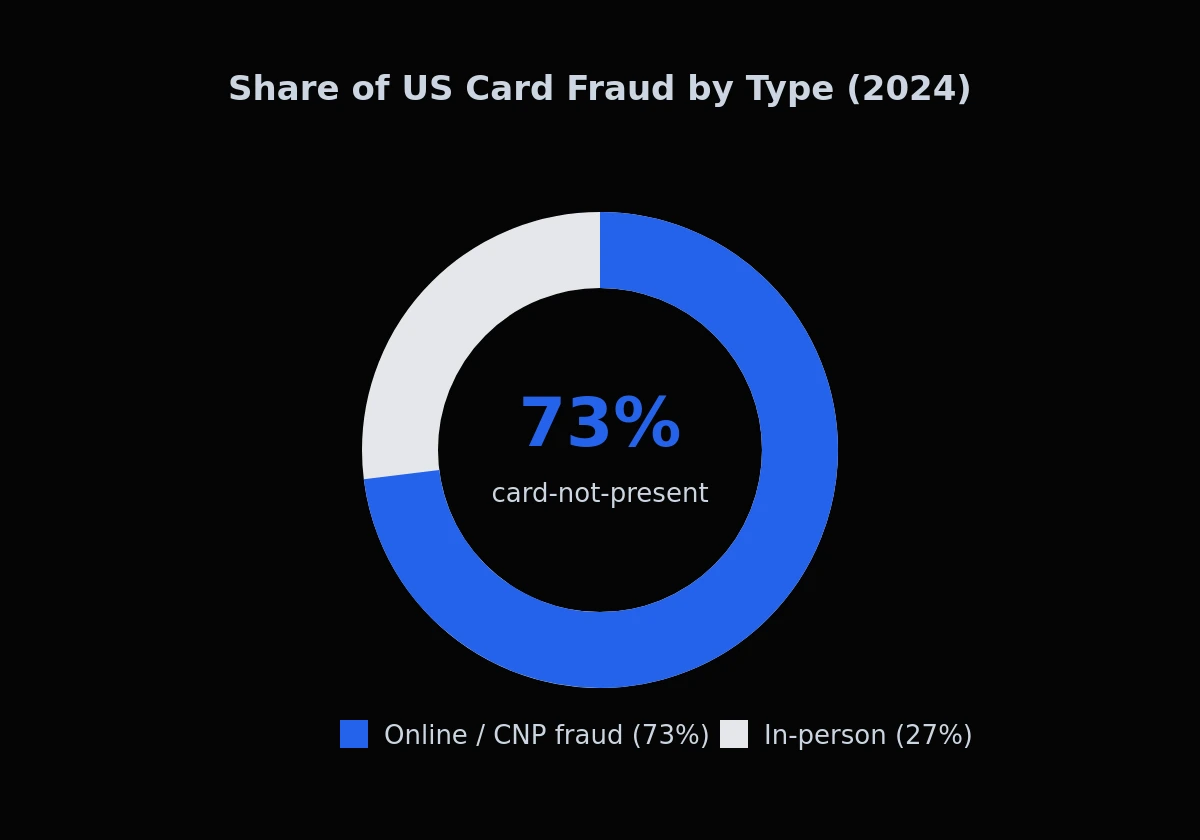
This shift matters for how you defend yourself. EMV chips, tap-to-pay, and PIN codes protect in-person purchases. None of them help when someone types your stolen number into a checkout page from another continent. Card-not-present fraud is now 81% more likely than in-store fraud, per Featurespace's CNP fraud research.
So the honest answer to "is my card safe?" is: your plastic is safer than it's ever been. Your number is not.
Related: phishing awareness and security training
How Can You Protect Your Credit Card? 10 Steps That Actually Work
For the endpoint protection layer behind many account and device attacks, see what antivirus software does and how EDR differs.
Turning on transaction alerts is the single highest-impact move, because it collapses fraud detection time from weeks to seconds. From there, the FTC's consumer guidance and our own incident-response experience point to the same short list. Work through it top to bottom.
- Turn on real-time transaction alerts. Every charge, every card, pushed to your phone. Fraud you see in seconds is fraud you can kill in minutes.
- Use virtual card numbers for online shopping. A disposable number per merchant means a breached store can't leak your real card. Virtual cards already carry 31% of B2B payment volume in 2025, up from 19% in 2022, per Mordor Intelligence's virtual cards market report — consumers should copy that playbook.
- Pay with tokenized wallets (Apple Pay, Google Pay). The merchant never sees your real number. Mastercard reports more than 35% of its transactions are now tokenized, per Payments Dive's 2025 coverage.
- Enable two-factor authentication on bank and email accounts. Your email is the master key to every card account you own. Protect it like one.
- Never save your card on merchant sites. Convenience is a liability when the merchant gets breached. Let your password manager or wallet fill it instead.
- Check physical readers before you swipe. Wiggle the card slot at gas pumps and ATMs. Skimmers are designed to look factory-fitted — and they compromised 243,000+ cards in 2025, per FICO.
- Treat every "bank" text as hostile until proven otherwise. Don't tap links. Call the number on the back of your card. Texts were 2025's top fraud contact method, per the FTC.
- Review statements monthly — including the small stuff. Criminals test cards with $1-2 charges before going big. A weird $1.47 charge is a warning shot.
- Freeze your credit with all three bureaus. It's free, takes ten minutes, and blocks the new-account fraud that made up 91% of 2025's card identity theft reports.
- Use unique passwords per financial account. Credential stuffing only works when you reuse passwords. One password manager beats a hundred clever variations you'll forget.
From our incident-response work: the compromises we investigate almost never start with a "hacked bank." They start small — a reused password, a saved card on a breached e-commerce site, a text message tapped in a hurry. The boring defenses on this list are the ones we consistently see stop real attacks.
What Should You Do If Your Card Is Compromised?
Act within 24 hours and your legal exposure is minimal: under the Fair Credit Billing Act, your maximum liability for unauthorized credit card charges is $50, and every major US network waives even that under zero-liability policies, per FTC consumer guidance. The money usually comes back. Your time is the real cost — so move fast and in this order:
- Lock or freeze the card in your banking app. Instant, reversible, and it stops the bleeding while you sort out the rest.
- Call the issuer and report the fraud. They'll cancel the card, reissue it, and open a dispute for the bad charges.
- Change the passwords on your bank account and email. If the fraud came from a breach or phishing, the card may not be the only thing exposed.
- File a report at IdentityTheft.gov if personal info (not just the card number) was exposed. You'll get a recovery plan and documentation for disputes.
- Watch statements for 60 days. Fraudsters often sell data in batches — a second wave weeks later is common.
One number worth knowing: chargeback volume is projected to hit 337 million cases globally by the end of 2025, a 27% jump from 2022, per Mastercard-commissioned Datos Insights research cited by BlueSnap. Disputes work, and banks process millions of them. Don't hesitate to file one out of some sense that the loss was your fault. It wasn't.
Are Virtual Cards and Tokenization the Future of Card Security?
Yes — and the shift is already measurable. Tokenized transactions are projected to double from 283 billion in 2025 to 574 billion by 2029, according to Glenbrook Partners' 2025 tokenization analysis, and both Visa and Mastercard have stated goals of near-universal token adoption by 2030.
Here's why that matters in plain terms: tokenization replaces your 16-digit card number with a single-use or merchant-locked stand-in. Steal the token and you've stolen a key that opens nothing. If every checkout used tokens, the entire dark web card market — those 140 million listed records — would be selling dead numbers.
We're not there yet. Until then, the gap between "tokenized" and "raw card number" transactions is exactly where you should focus: use wallets and virtual cards wherever they're accepted, and save the physical card for places that have earned your trust.
Related: cybersecurity for small businesses in India
Worried about your business's payment security, not just your own wallet? Arica Tech helps companies harden payment flows, meet PCI DSS requirements, and respond to card-data incidents. Get a free security assessment →
Frequently Asked Questions
Can someone use my credit card with just the number?
Yes. For online (card-not-present) purchases, a criminal typically needs only the card number, expiry date, and CVV — no PIN, no chip, no physical card. That's why CNP fraud made up 73% of US card fraud in 2024, per BlueSnap's analysis of Federal Reserve data.
Is it safe to save my card on websites?
It's convenient, not safe. Every merchant that stores your card is a potential breach point, and in 2025 over 140 million stolen card records were listed on dark web markets, per Panda Security. Use a tokenized wallet or virtual card number instead of saving raw card details.
How much am I liable for if my credit card is stolen?
Very little, if you report it. The Fair Credit Billing Act caps your liability for unauthorized credit card charges at $50, and Visa, Mastercard, American Express, and Discover all offer zero-liability policies on top, per FTC consumer guidance. Report promptly and you'll typically pay nothing.
What's the most common way credit cards get stolen in 2026?
New-account fraud leads: 91% of credit card identity theft reports in 2025 involved accounts opened in the victim's name, per FTC data cited by The Motley Fool. For existing cards, phishing texts and merchant data breaches — not physical theft — drive most compromises.
Do EMV chip cards prevent fraud?
They prevent counterfeit in-person fraud very effectively — which is exactly why fraud moved online. Since chip adoption, US card-not-present fraud climbed from 57% of card fraud in 2019 to 73% in 2024, per BlueSnap. Chips protect your plastic, not your number.
The Bottom Line
Card fraud is a $33 billion industry run like a business, with subscription tools and wholesale pricing. You can't opt out of that reality — but you can make yourself a bad customer for it.
- Alerts and 2FA catch fraud in seconds instead of weeks.
- Virtual cards and tokenized wallets make stolen numbers worthless.
- A credit freeze blocks the new-account fraud behind 91% of card identity theft.
- And if something slips through, the law caps your loss at $50 — usually $0.
Set aside 30 minutes this week and work through the ten steps above. It's the cheapest insurance you'll ever buy.
Sources
- Nilson Report, Card Fraud Losses Worldwide — 2024, retrieved 2026-08-17, https://nilsonreport.com/articles/card-fraud-losses-worldwide-2024/
- Payments Dive, Card fraud losses will increase over next decade, retrieved 2026-08-17, https://www.paymentsdive.com/news/payments-fraud-losses-prevention-nilson-outlook/737440/
- The Motley Fool, Identity Theft and Credit Card Fraud Statistics for 2025, retrieved 2026-08-17, https://www.fool.com/money/research/identity-theft-credit-card-fraud-statistics/
- Experian, U.S. Fraud and Identity Theft Losses Topped $15.8 Billion in 2025, retrieved 2026-08-17, https://www.experian.com/blogs/ask-experian/identity-theft-statistics/
- FICO, The State of Card Skimming in the US: 2025 Year in Review, retrieved 2026-08-17, https://www.fico.com/blogs/state-card-skimming-us-2025-year-review
- BlueSnap, Card-Not-Present Fraud Is On the Rise, retrieved 2026-08-17, https://www.bluesnap.com/card-not-present-fraud-statistics/
- Featurespace, Protect against card-not-present fraud, retrieved 2026-08-17, https://www.featurespace.com/knowledge-hub/card-not-present-fraud
- Panda Security, 52 Dark Web Statistics for 2026, retrieved 2026-08-17, https://www.pandasecurity.com/en/mediacenter/dark-web-statistics/
- StingRai, Dark Web Data Pricing 2026: Verified Prices, retrieved 2026-08-17, https://www.stingrai.io/blog/dark-web-data-pricing-2026
- Payments Dive, Visa, Mastercard push more tokenization, retrieved 2026-08-17, https://www.paymentsdive.com/news/visa-mastercard-push-more-tokenization/759762/
- Glenbrook Partners, We (Really) Can't Stop Talking About Tokenization: A 2025 Update, retrieved 2026-08-17, https://glenbrook.com/payments_views/we-really-cant-stop-talking-about-tokenization-a-2025-update/
- Mordor Intelligence, Virtual Cards Market Size, Growth Report & Share Analysis, retrieved 2026-08-17, https://www.mordorintelligence.com/industry-reports/virtual-cards-market
- FTC, Lost or Stolen Credit, ATM, and Debit Cards (consumer guidance), retrieved 2026-08-17, https://consumer.ftc.gov/articles/lost-or-stolen-credit-atm-and-debit-cards
Need this in your own environment?
Arica Tech Security runs VAPT, ISO 27001 readiness support, and digital forensics engagements for teams in India and beyond.